
“Wise men still seek Him.”
It’s on mugs and bumper stickers, framed in gold at Christmastime. It’s noble. Calm. Almost decorative.
But seeking did not begin in Bethlehem. It began in a garden. After Adam and Eve stitched fig leaves together and hid among the trees, the Lord God walked in the cool of the day and called out, “Where are you?” (Genesis 3:9).
That is the first seeking in Scripture. And it is not man searching for God. It is God searching for man.
By the time wise men followed a star in Matthew 2, the pattern was already ancient. From the beginning, God has been moving toward people who hide and wander, and men and women—flawed and faltering—have been seeking Him in return ever since.
So when we say, “Wise men still seek Him,” we are stepping into something far older than Christmas decor. Seeking Jesus has never been sentimental. It reaches deeper than tradition. It’s life-altering.
Consider Peter.
Tucked quietly into Mark 1:36 is a line that could summarize his whole biography: “Simon and his companions went searching for Him.”
That’s Peter in a sentence.
The seeking never stopped. He moved toward Jesus on the water — and began to sink (Matthew 14:29–30). He followed Jesus from a distance into the high priest’s courtyard—and denied Him three times (Matthew 26:58, 69–75). He ran to the tomb when he heard the stone had been rolled away (Luke 24:12). He threw himself into the sea when he recognized the risen Christ on the shore (John 21:7).
Peter was impulsive. Inconsistent. Loud. Often wrong. But he was always seeking Jesus.
And Peter is not alone.
King David carried the same pattern. Scripture tells us that God said, “I have found David… a man after My own heart.” That is a startling testimony—especially when you remember 2 Samuel 11.
That chapter tells a painful story: adultery with Bathsheba, a calculated plan that sent Uriah to his death, and a season of silence thick with guilt. David’s collapse was not private. It was national, public, devastating.
Then Nathan stood before him and told the story of a stolen lamb. And when the prophet finally said, “You are the man” (2 Samuel 12:7), David did not argue. He did not deflect. He did not run. He said, “I have sinned against the Lord” (2 Samuel 12:13).
Then came Psalms 51—not a strategy for image repair, but a prayer: “Create in me a clean heart, O God…” He fell hard. But he fell toward God.
Jeremiah preserves the promise: “You will seek Me and find Me when you seek Me with all your heart” (Jeremiah 29:13). Hebrews adds that God “rewards those who diligently seek Him” (Hebrews 11:6).
Scripture never says the seekers are spotless. But it shows us they keep turning their faces toward the Lord. The difference is not perfection. It is direction.
We will stumble. Some of us spectacularly. Words we wish we could take back. Decisions that ripple farther than we imagined. Seasons where we drift. The deeper question is not, “Did you fail?” It is this: when you saw it clearly—which way did you move? Toward Him? Or away?
And then Jesus says something astonishing to a Samaritan woman at a well—a woman with five husbands and a complicated past: “The Father is seeking such to worship Him” (John 4:23).
The Father is ever seeking — not waiting, not indifferent, … seeking.
Which means the conviction that won’t quite leave you alone, the quiet whisper that calls you by name, is not random. It is evidence of His pursuing love—a nudging.
Seeking is not just our movement toward Him. It is our response to His movement toward us.
Wise men still seek Him. So do fishermen who sink. So do kings who have wrecked things. So do ordinary people like you and me.
The question isn’t whether you’ve stumbled.
The question is: Who are you seeking?
-

-

“My soul yearns for you in the night; in the morning my spirit longs for you. When your judgments come upon the earth, the people of the world learn righteousness.” — Isaiah 26:9, NIV
I still remember the day I found gold.
I was out with my uncle doing some exploring — hunting fossils, turning stones, doing what boys do in the summer sun. And then I saw it, gleaming in the light — a solid chunk of gold. I snatched it up, slipped it into my pocket, and hurried toward my uncle. My imagination was already racing. We were rich. Dad wouldn’t have to work anymore. I could get a new bike. And candy? Endless.
When I finally showed my uncle my treasure, he smiled — the kind smile of someone who has seen this before — and gently said, “Sorry, that’s pyrite. Fool’s gold.”
My illusions of grandeur collapsed. It looked real. It shone like the real thing. I was certain it was true. But it wasn’t.
Sooner or later, what is false is revealed.
We are living in an age of exposure. Preachers fall. Leaders are unmasked. Hidden things surface. Files opened. Illusions collapse. For some, it is disorienting. For others, it is confirming. For many, it is simply exhausting.
But notice what Isaiah does not say. He does not say, “When scandals break, the people learn cynicism.” He does not say, “When leaders fall, faith collapses.” He says,
“When Your judgments come… righteousness is learned.”
In Scripture, judgment is not God losing His temper. It is God setting things right. It is light entering shadow. It is truth refusing to remain buried.
God is not threatened by fraud. Truth does not panic when imitation is revealed. Gold is not nervous when fool’s gold flakes.
When exposure comes, it feels like night. Disillusionment carries a darkness of its own. But Isaiah links night with yearning: “My soul yearns for you in the night…”
Sometimes the collapse of illusion clarifies the object of our longing. When platforms crack, foundations are tested. When charisma fades, character matters again. When performance disappoints, prayer regains its quiet strength.
I recently spoke with a friend who had been personally affected by a prophetic ministry that later came under scrutiny. The exposure was jarring — disorienting for a moment. But what proved stronger was this: long before anything became public, God had already been whispering to him and his wife — through Scripture, through what he described as a quiet “check” in their spirits, and through the steady wisdom of godly counsel. Over time, a growing assurance formed that this was not the final word. When the truth about the ministry surfaced, it startled my friends for a moment, but it did not undo God’s faithfulness.
Because the Kingdom is not built on personalities. It is built on a crucified and risen Christ. And Christ does not fall. Exposure, painful as it can be, is not the end of the story. Sometimes it protects the vulnerable. Sometimes it awakens the naive. Sometimes it purifies the church’s appetite.
And sometimes — quietly — it drives us back to the only One who cannot be shaken.
Night comes. But morning clarifies. When God lets the light in, it is not to undo us. It is to steady us again on what cannot be shaken — to what is genuine, what is tested, what endures — not a preacher, not a leader, not a movement, not a moment.
But Jesus. -

As a kid, I remember my grandma using the word rich in a particular way. She didn’t mean expensive. She wasn’t talking about money at all. Rich was her word for something that had more in it than you expected—more than you could easily handle, in the best possible way.
If a dessert had layers—real butter, heavy cream, something baked slowly and generously—she’d take one bite, pause, and gently say, “Mmm…” And then, with a soft smile, she’d add, “Oh my… that’s rich.”
What she meant was simple: you don’t rush this. You let it sit. Rich food isn’t meant to be devoured. It’s meant to be received—and savored.
That’s how Isaiah 55 feels.
Not long. Not complicated. But so full that if you hurry through it, you miss what it offers.
Isaiah 55 speaks into a weary moment. God’s people had known loss and displacement—much of it of their own making. They had labored for what did not last and trusted what did not satisfy.
Into that weariness, God speaks—not with accusation or instruction, but with invitation:
“Come! All you who are thirsty!” (v. 1)
God names the need—thirst, hunger, lack. And then He asks a question that feels less like theology and more like a conversation at my grandma’s kitchen table:
“Why spend your money on what is not bread, and your labor on what does not satisfy?” (v. 2)
That is not condemnation. It is a Father connecting exhaustion with emptiness.
Why are you so tired—and still so hungry? Why all the effort, the late nights and early mornings, and yet something in you still feels underfed? God isn’t shaming the hunger; He is questioning the substitutes.
Then He speaks plainly: “Give ear and come to me; listen, that you may live.” (v. 3)
Not more effort. Not self-repair. Not proving yourself.
Listen.
Life doesn’t begin with striving. It begins with listening—to a promise, to a voice, to a covenant mercy that precedes your failure. We are very good at motion—very practiced at activity—but often starving for attentiveness.
As the chapter unfolds, God anchors the invitation in His own faithfulness—not in their track record, but in His. He has been steady, even when they have been scattered.
And then the prophet’s voice rises:
“Seek the Lord while he may be found; call on him while he is near.” (v. 6)
While.
There is a now-ness to grace. It is abundant—but it is not meant to be postponed. The urgency is not a threat. It is kindness. The one who turns will find compassion. The one who returns will discover pardon—freely given.
And just when that mercy begins to sound almost too generous, the Lord says:
“My thoughts are not your thoughts…” (v. 8)
As if to answer the quiet objection rising in us—surely not… it can’t be that simple…
But it is.
His grace runs deeper than our logic. His mercy cannot be measured. His goodness stretches beyond imagination. It gently dismantles the quiet belief that God must think as we think, react as we would, see things as we see them.
He does not.
You do not have to understand Him fully to trust Him truly.
Then Isaiah gives an image his hearers would have understood deep in their bones—rain falling from heaven (v. 10–11). In a dry land, rain was not decoration; it was survival. It came from above, soaked into thirsty ground, and in time produced life—seed for the sower, bread for the eater.
So it is with His Word. It is unhurried, certain, effective. It descends. It sinks in. It accomplishes what He sends it to do. Some seeds bloom quickly; others lie hidden for a season. But none of His words return empty.
The chapter ends with joy—the kind weary exiles would ache for: peace, mountains singing, trees clapping their hands, thorns replaced by fruit. Not just repair—restoration.
And it is all “for the Lord’s renown” (v. 13)—for His Name and for His glory.
The story ends where it began—with a generous God who invites, pursues, speaks, and restores.
The invitation is still open: “Come to me, all you who are thirsty.” Come. Listen. And live.
Mmm… that’s rich. -

“You forgave the iniquity of your people and covered all their sins. Selah.”
—Psalm 85:2, ESV
Some words in Scripture explain things. Others interrupt us—inviting us to stop, and to stay.
Selah is one of those words.
Depending on your translation, it may show up plainly—or quietly disappear. In some Bibles it’s replaced with Interlude. In others, it’s pushed to the margin, asterisked and explained away in a footnote—as if we’re not quite sure what to do with it.
Which may be the point.
Biblical scholars have offered careful theories about Selah—suggesting it may have been a musical or liturgical marker, a cue for reflection or transition in Israel’s worship. Even the most trusted voices admit that its precise meaning remains uncertain.
Selah is not a word we master. It’s a moment we enter. A pause that refuses to be rushed. A space where Scripture stops talking at us and waits to see what we’ll do with what’s just been said.
What Psalm 85:2 declares is no small thing. God did not overlook the sin of His people. He did not minimize it or manage it. He forgave it. He covered it.
And then … Selah.
It’s as if the psalmist knows that if we move on too quickly, we’ll miss it. We’ll turn mercy into a concept instead of an experience. We’ll nod our heads without letting grace go all the way down.
Scripture leans into this language again and again—linking forgiveness with covering, and blessing with mercy received:
“Blessed is the one whose transgressions are forgiven, whose sins are covered.”
—Psalm 32:1, ESV
Covered—not with paint or polish. Not with religious language or respectable behavior. Covered at cost. Covered completely. Covered in a way that protects us from what we deserve.
Scripture never speaks of covering as concealment from God, but protection by God. Blood on doorposts. Blood on the mercy seat. A scarlet thread stretching across history, culminating at the cross.
Selah is the moment we stop explaining—and start sitting with it.
Because here’s the truth: we’re not great at going deep. Depth requires stillness. Stillness requires honesty. And honesty means getting real—about our sin, our shame, our fear, and the exhaustion of keeping up appearances.
We prefer veneer—the thin layer that lets us look fine without being healed.
We keep moving. Keep producing. Keep talking. Keep scrolling. Even in our faith, we’re tempted to rush past forgiveness to get to instruction. Past mercy to get to maturity. Past grace to get back to work.
But God does His deepest work in the pause. Selah marks the difference between religion and relationship. Religion treats forgiveness as a transaction—checked off and filed away. Relationship lingers long enough to be changed by it.
Selah is the thin space where mercy does more than inform us. It is the threshold—the place where the Great Physician doesn’t just diagnose, but heals—slowly, personally, thoroughly.
And we avoid it.
We run from Selah because it exposes our need for control. It asks us to stop performing and start receiving—to trust that forgiveness is not only real, but sufficient.
It’s where real life begins. And this is where Jesus comes into view. He didn’t come as an idea to be understood. He came in flesh. He stepped into our suffering, carried our sin, and stays with us still.
Selah is where that stops being theory. It’s where we don’t rush past the pause or explain away the silence. It’s where we stay, breathe, and let mercy finish what it has started.
I can’t define Selah, but I know what it does. It makes room—for Jesus.
Selah. -

Forgetting what is behind and straining toward what is ahead, I press on toward the goal… in Christ Jesus.
—Philippians 3:13-14, NIV
A few weeks ago my wife and I had what I can only describe as a surreal experience.
Our daughter and son-in-law lead worship at a church near us, and we couldn’t make the service that Sunday, so we did what so many of us do now—we watched the livestream on YouTube.
My wife cued it up on our TV, and there we were, sitting comfortably on the couch, worshiping from home. It felt live. Current. Present.
Or so we thought…
As we watched, we noticed a couple of things. My son-in-law had a fresh haircut. We had just been with him the day before, so we commented on his dedication—wow, he must have gone to the barber early Sunday morning. (Their service isn’t until later in the afternoon.)
Then we noticed our daughter was wearing glasses. She only does that once in a while. She hadn’t been wearing them the day before, and we found ourselves wondering why she had them on that day.
The service itself was meaningful. The music was great—they always do so well. We were engaged—emotionally, spiritually, relationally. Everything about it felt real-time…live.
The next day I went to get a haircut. My son-in-law and I share the same barber. As the barber and I talked, I mentioned how sharp Pedro’s haircut looked on Sunday. The barber looked puzzled.
He said, “I haven’t cut his hair yet. He’s scheduled for next week.”
Huh?
At first, I assumed there was some confusion. But over the course of the week, the truth slowly came into focus. The church hadn’t actually livestreamed that Sunday. My wife had unknowingly pulled up a service from a couple of months earlier—back when Pedro’s hair was shorter and our daughter wore her glasses regularly.
We thought we were watching something live. But we were living inside old footage.
When we told our kids, they laughed—hard. And rightly so. We deserved it. But after the laughter faded, the moment stayed with me. Because here’s the strange thing:
That old service shaped our present reality.
It affected our conversations. Our assumptions. Our reactions. Even our emotions. We responded sincerely—to something that wasn’t actually happening. And I wonder how often we do the same thing spiritually.
How often do we live as if the truest reality is what we can see, replay, or assume? How often are we shaped by the constant churn of headlines—current concerns, familiar fears dressed up as breaking news, old wounds reopened again and again—rather than by what God is doing now?
Scripture reminds us that the most real world is not always the most visible one.
“So we fix our eyes not on what is seen, but on what is unseen. For what is seen is temporary, but what is unseen is eternal.”
(2 Corinthians 4:18, NIV)
There are principalities and powers. There is brokenness and resistance. But there is also Jesus—present, reigning, interceding. There is a Father who loves us. There is heaven nearer than we think. There is hope that is not outdated.
Sometimes we live as if grace is old footage. As if resurrection power was for another time. As if the nearness of God is something we remember rather than experience. But the gospel is not a replay. Jesus is not archived. The Spirit is not delayed. The Kingdom of God is not buffering.
The truest reality is not behind us. And it’s not just on the screen in front of us. It is found in Him.
That’s why Paul could speak of letting go of what lies behind and pressing on toward what lies ahead—not because the past didn’t matter, but because it no longer defined him. Our eyes and hearts are meant to be fixed on Jesus—not as a memory, not as a concept, but as reality itself.
He is the truly live presence of God.
When our eyes are fixed on Him, we are no longer living in yesterday’s story or borrowed assumptions. He becomes our present reality. We are awake to what is actually happening. Now.
He is not merely remembered. He is encountered.
Jesus is very much alive. And in Him, so are we. -

[I’m currently working on a new book called The Best Miles, a reflection on faithfulness, aging, and the ways God continues to use our lives for His glory. The book is still taking shape, but what follows is one “nudging” from that work. Thanks for reading.]
Therefore we do not lose heart. Though outwardly we are wasting away, yet inwardly we are being renewed day by day. For our light and momentary troubles are achieving for us an eternal glory that far outweighs them all.
—2 Corinthians 4:16-17, NIV
I didn’t begin my walk with Jesus until I was fourteen. But long before that—before I knew what faith was or why it mattered—my praying grandmother would take me to church whenever she could.
She attended a small, run-down Pentecostal church—the kind you might drive past without noticing, the kind that didn’t try to impress anyone.
The pastor was Brother Baker. His wife was Sister Baker. Godly people. No polish. No pretense. Faithful. Loving.
Church felt foreign to me then—the rhythms, the language, the expectation that God was present and listening. It was all new, and it left impressions I didn’t yet know how to name.
When it came time for Sunday school, the kids were sent downstairs—down thin, narrow concrete steps into a dank, musty basement. A handful of us would sit on the floor while Sister Baker, wearing horn-rimmed glasses and her gray hair pulled tight into a bun, kindly taught us about… the love of Jesus.
She used something I had never seen before.
A flannelgraph.
She would sit beside a felt-covered board, tell the story, then reach into a pile of paper figures—people dressed in Bible-time clothes, a donkey, a giant, a rock tomb, and a large plant that looked suspiciously like a coconut tree—and one by one press them onto the board until the story came to life.
She smoothed each figure with her fingers, gently but deliberately. And somehow, they stayed… most of the time.
Some figures didn’t stick very well.
Zacchaeus, for instance—we heard about him a lot—was worse for wear. The apostle Paul too. Even the figure of Jesus had seen better days.
These figures were wrinkled. Bent. Floppy. Worn thin. Some had been taped back together. They’d lost their crisp edges. Their corners curled. They slid slowly downward—or sometimes fell off altogether—no matter how carefully Sister Baker pressed them into place.
They were clearly used—and they told the best stories.
Paul was especially hard to keep in place—tattered, taped, unreliable. He leaned. He drooped. He sometimes fell.
Which I now see is fitting.
Because Paul was the one who wrote about being poured out like a drink offering. The one who spoke of being hard pressed on every side, but not crushed. The one who admitted plainly that outwardly we are wasting away, though inwardly something deeper is being renewed day by day.
Even as a child, I could feel it—not the theology, but the weight of it. These stories mattered. They carried gravity. They had been lived before they were ever told.
The figures that didn’t stick easily were the ones that had been handled the most—the ones that had been brought out again and again, the ones trusted to carry the weight of the story.
There is something about that image—about that childhood experience—that has stayed with me all these years.
Because it tells the truth.
The figures that are perfect and pristine don’t carry the same authority. The unused ones don’t hold the room. The stories that matter most are told by lives that have been handled, bent, repaired, and trusted again and again.
Age does that. So does faithfulness.
If you feel a little like one of those figures—creased by time, taped by grace, less likely to stand upright on your own—you are not diminished.
You are seasoned. Your edges tell a story. Your wear is evidence. Your weakness is not a liability—it is your credibility. You may not “stick” the way you once did. You may need a steadier hand. You may lean more than you stand.
But you carry the story.
And in the end, the ones that don’t stick easily are often the ones that stick with us—the ones that shape us, steady us, and quietly change the world.
They’ve been used.
And God is still using their lives to speak of… the love of Jesus. -

Praise the Lord! Oh give thanks to the Lord, for He is good; for His steadfast love endures forever.
—Psalm 106:1 (ESV)
That phrase—“Give thanks to the Lord, for He is good; for His steadfast love endures forever”—is one of the great pillars of Scripture.
It appears again and again throughout the Old Testament—spoken, sung, proclaimed, and remembered. Sometimes it rises from moments of celebration. Sometimes it’s whispered in desperation. Often it’s heard in seasons when the evidence on the ground didn’t seem to match the confession on the lips.
Which makes me wonder if the power of that line isn’t only in how often it’s repeated in Scripture, but in how often it’s meant to be repeated in us.
Because all of us live with a recurring voice. It plays in the background of our minds—a sentence that resurfaces when we’re tired, a phrase that shows up when things are hard, or when we feel small, or when we fail.
Some of those voices are harsh and defeating: You’re behind. You’re not enough. You’ll never change.
But not every recurring voice is destructive. Some are redemptive. Some are anchors. Some are gifts handed to us long before we knew we’d need them.
One of mine came from my grandad.
I grew up on a small corner of his farm, and it was my privilege to spend my childhood working alongside him—milking cows, irrigating fields, feeding cattle, stacking hay, fixing fences, picking rock from the fields, and repairing whatever broke that day. In the midst of that work, as a kid I had a bad habit of saying, “I can’t.”
I’d try to roll a heavy hay bale into place. “I can’t.”
I’d reach into a tight spot to grab a dropped bolt. “I can’t.”
I’d struggle to pound a nail straight. “I can’t.”
Every time, my grandad would look at me—never harsh, never irritated—and say the same thing:
“Aww… can’t died.”
That was it. No lecture. No shame. Just a matter-of-fact declaration. In other words, can’t didn’t live there anymore. It had no authority. It didn’t get to decide what was possible—leaving only try and can.
Decades later, when the work feels heavy, the task feels beyond me, or fear whispers that I’m incapable, that old phrase—can’t died—still comes to mind. Not as a slogan or a strategy, but as a remembered voice—steady, patient, and kind. Before I argue with fear or try to outthink it, those simple words rise up and do what they’ve always done: they make room.
Scripture is clear about the source of the voices that diminish and accuse. They do not come from the Father who delights in His children. They come from the enemy who lies and condemns.
But Scripture is just as clear about the voice God gives His people—a refrain meant to be remembered when courage runs thin:
“The Lord is good. His steadfast love endures forever.”
Not because everything is easy. Not because we are strong. But because God is faithful—and He has not left us to face the work alone.
Scripture does not speak of God’s steadfast love as a distant idea or an abstract quality. It speaks of it as something living and enduring—something that comes near. And in the fullness of time, that steadfast love did not remain only a phrase to be repeated, but it became a life to be encountered. God’s goodness took on flesh—loving, patient, and kind—and moved into the midst of our fear and failure.
Maybe that’s why Scripture repeats that line so often. Not to inform us, but to re-form us. To crowd out the voices that tell us who we aren’t with the truth of who God says we are.
So here’s the invitation: carefully consider the voice that repeats itself in you. Notice what it says when you’re tired. Listen to what it tells you when you’re afraid. And if it is not rooted in the goodness of God and the endurance of His love, it does not get the final word.
Some voices need to be challenged. Some need to be replaced. Some need to be laid to rest.
After all—can’t died.
And Jesus—the steadfast love of the Lord—is very much alive. -

[A brief word before you read: This reflection is not my usual weekly Nudging. It’s a quiet response to a recent public disclosure involving a well-known Christian voice—one that has stirred grief, questions, and reflection for many. I offer it not as commentary or conclusion, but as a quiet reflection—shared in humility and hope.]
The Final Word
I am the bread of life. Whoever comes to me will never go hungry. —John 6:35, NIV
Most of us know the raven before we ever meet it in Scripture.
It comes to us through literature—black, inky, elegant, and eerie. Perched above a grieving man’s door, answering every question with a single word: Nevermore. In The Raven, the bird does not rage or argue. It simply echoes what sorrow already says.
The raven has come to symbolize finality—the quiet suspicion that loss, failure, or regret will have the last word. But long before Edgar Allan Poe gave the raven a voice of despair, Scripture had spoken.
After the flood, Noah sends out a raven. It does not return, moving back and forth over a world not yet made whole. In drought, ravens bring bread and meat to the mighty prophet Elijah—what once circled carrion was entrusted with holy provision. Solomon, sage and poet, dares to liken raven-black hair to beauty.
Scripture refuses to issue a single verdict on the raven.It appears in places of death and in moments of provision. It lingers where endings are visible, and it arrives where sustenance is needed.
And then there is the creature itself.
Ravens are brilliant. Curious. Drawn to sparkle—foil, glass, coins, anything that catches the light. They explore. They gather. They fixate. Often associated with transition, sorrow, and death, they are also noted for fidelity and hope. They mate for life, giving their attention to one alone. A single eye. A fixed devotion.
Contradictions, held in contrast.
Which is why the story eventually turns toward us.
Because the truth is, we recognize something of ourselves here. We know what it is to be attentive and distracted at the same time. To desire faithfulness, yet feel the pull of lesser things. To be capable of devotion, and still drawn to what catches the light. To want depth, but settle for what is close at hand.
We are not just observers of the raven.
We are the raven.
Not evil.
But human—and hungry.
In other words, ravenous. At its root is the word raven. A raw, impatient appetite. Not always for sinful things—but for closeness, affirmation, intimacy, relief, meaning, and satisfaction. We are gifted. Intelligent. Capable of beauty and devotion. And still, drawn to what glitters. Still tempted to live on what sustains us just enough, rather than what restores us fully.
Scripture has a name for this kind of hunger.
“Watch out for the Esau syndrome,” Hebrews warns. “Trading away God’s lifelong gift in order to satisfy a short-term appetite” (Heb. 12:16, MSG).
Esau wanted the blessing back later—but the moment had passed. Tears could not undo what hunger had already chosen.
Hunger rarely announces its cost in advance. This is the danger Scripture names—not hunger itself, but appetite left unattended. A loss we never meant to choose. A kind of Nevermore that arrives quietly, one small decision at a time.
Recently, a story surfaced that many of us wish we had not read. A story in the news and on social media that carries grief, not gossip. A failure measured not in moments, but in years—where wonder slowly gave way to wandering, and a covenant was broken. It unsettles us. Disillusions us. And reminds us—again—that spiritual language, wisdom, and calling do not cancel appetite.
It is tempting, in moments like these, to read critically—but from a safe distance. To imagine the story points outward at another, even as it quietly turns and points back at us. And it is there—without accusation—that Scripture speaks.
Scripture does not shame our hunger. It questions our substitutes.
“Why spend money on what is not bread, and your labor on what does not satisfy?” (Isa. 55:2, NIV)
God asks—not to scold, but to invite. Sparkle is not bread.
Jesus never rebukes the hungry. He feeds them. “I am the bread of life,” He says—not a distraction, not a glittering substitute, but nourishment. What sustains. What satisfies. What is essential.
The raven survives on what it finds. Jesus offers us what we actually need.
And when the haunting voice of the raven whispers again—
that failure is final,
that hunger defines us,
that brokenness has the last word—
the gospel answers without spectacle or force:
Amazing grace.
God is our strength and our portion. He feeds the ravens, and He Himself is our food. He invites us to come—not to what sparkles, not to Nevermore, but to Jesus, the Bread of Life—bread enough for today.
Where grace—not hunger—gets the final word. -

Sadly, many of us would not pray if we weren’t driven to our knees.— Ben Patterson
I’ve walked with the Lord for more than forty years. I share that not as a credential, but as context.
I felt called into ministry in my twenties. I was ordained. I preached and taught. I led worship, opened Scripture through both spoken word and written reflection, officiated weddings and funerals, dedicated babies, baptized believers, prayed with people in hospitals, led groups, discipled others, and encouraged people—again and again—to trust God with their lives.
Prayer was always part of my vocabulary and my practice. It just wasn’t always part of my dependence—and I didn’t know it.
That realization came as a surprise.
In the years leading up to 2019, my health began to unravel in ways I couldn’t explain. At first, it seemed manageable. I adjusted. I compensated. I told myself this was just aging, stress, life.
That’s what capable people do.
But the symptoms worsened. My thinking grew foggy. My body failed me without warning. I got lost on familiar roads. I said things that didn’t make sense. There were moments when I couldn’t move or respond at all.
Eventually came the diagnosis: a rare pancreatic tumor—an insulinoma. No medication. No simple fix. My body was undermining me from the inside.
And somewhere in that unraveling, something else came into focus.I realized I had been enduring the situation—but not entrusting it to God. I was functioning on experience, resilience, and self-reliance, while anxiously carrying a burden I was never meant to carry alone.
James writes,
“Consider it pure joy whenever you face trials of many kinds, because you know that the testing of your faith produces perseverance.” (James 1:2–3, NIV)
Testing has a way of revealing what our faith is actually resting on. It strips away the illusion of control and exposes how easily competence can masquerade as trust. And when testing turns into trouble, prayer becomes less of a discipline and more of a necessity.
James later writes:
“Is anyone among you in trouble? Let them pray.”(James 5:13, NIV)
Let them pray. Not analyze. Not manage. Not push through.
Pray.
That verse finally found me—not as a teaching point, but as a mirror. I had prayed for others in their trouble and encouraged them to ask for prayer. I had seen God act. And yet, I had not named my own need.
So I did.
I asked for prayer. I let others carry me when I could not carry myself. Healing was not immediate—but peace was. And with it came a deeper, quieter faith—one shaped not by strength, but by surrender, and by the steady awareness that Jesus had not stepped back from my suffering, but had drawn near within it.
Patterson is right. Sadly, many of us would not pray if we weren’t driven to our knees.
But when trouble finally tells the truth about us, graciously, God is willing to meet us there. And Scripture tells us what to do next:
… Let them pray. -
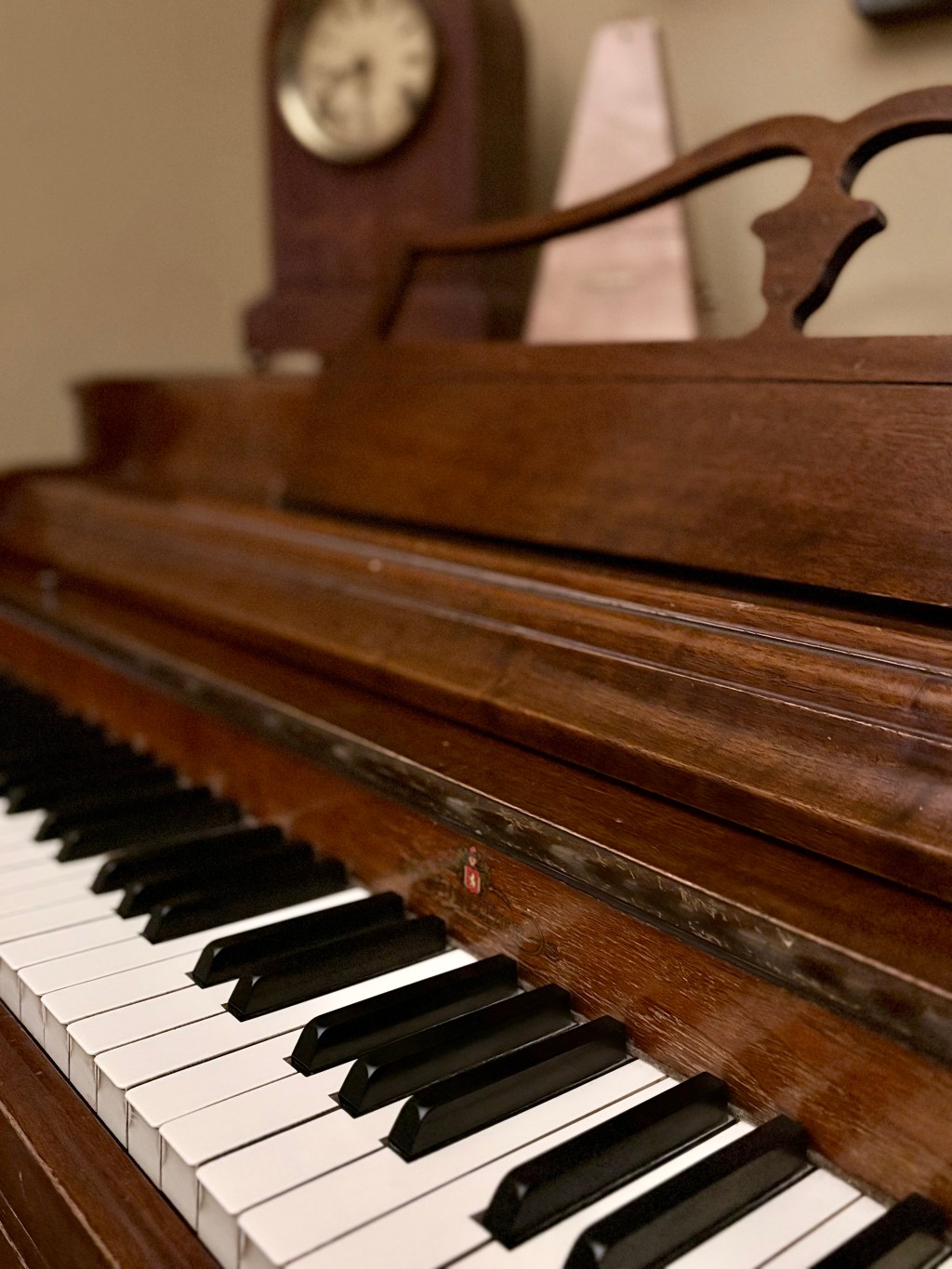
[On this New Year’s Eve, I wanted to share a piece I wrote years ago. May it be an encouragement as you step into the new year.]
My heart is steadfast, O God; I will sing and make music with all my soul. —Psalm 108:1 (NIV)
There are some things you understand early in life because someone tells you. And there are other things you understand later—not because they are new, but because you’ve lived long enough to hear them differently.
One of those for me is a simple phrase: It’s about the music.
That line comes from the movie School of Rock. Years ago, when our kids were younger we watched that silly movie again and again—laughing every time like it was the first. In a house of two teachers and four musicians, the story struck a familiar chord.
In one scene, Dewey Finn—played with over-the-top brilliance by Jack Black—walks into band practice only to discover he’s been voted out of the band. His excess, his passion, his twenty-minute guitar solos no longer serve the band’s goals. They want success. Stardom. The $20,000 grand prize in the Battle of the Bands.
Dewey is incredulous. With wild eyes and flying hair, he finally blurts out, “You guys just don’t get it. It’s not about the money… it’s about the music!”
At the time, it was funny. Years later, it’s instructive.
I didn’t realize how deeply those words had settled in me until I found myself repeating them to my twelve-year-old daughter, Becca, just minutes before her piano recital. She was preparing to play eight pages of Chopin—by memory, under bright lights, in front of a crowd. I could see the anxiety rising as she worried about getting it right.
I pulled her aside and put my arm around her shoulders.
“Becca,” I said, “you’ve done the work. You’ve practiced. You have the ability. You’ve played this beautifully at home many times. You have nothing to prove—to me, your mom, or yourself. This recital doesn’t define you. It isn’t even about you or your performance… it’s about the music.”
Something in her softened. A small smile appeared.
“You know the music,” I said. “Now let it flow through you. Play it from your heart. Enjoy it. Let its beauty ring out and touch the audience.”
Only later did I realize I was speaking to myself as much as to her.
Sitting in the audience that evening, listening to student after student play, tears surprised me. Amid Beethoven, Chopin, Schubert, and even a simple “London Bridge” from the Beginners Piano Book, I found myself hearing something beneath the notes.
The melody I heard was the music of our lives.
It was the sound of practice and discipline. Repetitious scales. Missed notes. Forgotten stanzas. Groans squeezed between school, chores, and homework. Made-up songs and playful detours—small escapes from the work that needed to be done.
I looked around the room and thought about the parents and grandparents who had heard these same pieces at home—out of tempo, interrupted by missed notes and halting starts, again and again. And it struck me: this was the real music. Not the recital, but the daily, faithful playing of it.
Watching Becca at the piano, I found myself holding my breath. My hands clenched at every falter—not in disappointment, but in hope—hoping she wouldn’t let a moment derail the whole. And as she played, I realized how much of life is lived this way: moving forward, note by note, learning not to stop when we stumble.
In my heart, I found myself whispering encouragement—Keep going.
Don’t be discouraged.
Move through the bauble.
Let it ring.
When she finished, her smile said everything. And as I applauded, a quiet recognition surfaced:
Life is rarely a single, defining performance. It is far more often a long season of practice.
Somewhere along the way, many of us are taught—explicitly or not—that life is all about the recital. The final presentation. The flawless execution. The grand prize. But the longer you live, the more you realize how much of life happens between the performances.
In God the Father’s eyes—or ears—it has always been about the music. The whole song. The daily faithfulness. The missed notes. The perseverance. The grace that keeps us playing even when the pages are long and the hands are tired.
God is not waiting for the final chord to listen. He has been present for the practice all along.
***
At the end of Becca’s recital, parents, students, grandparents, brothers, and sisters stayed to celebrate with punch and cookies. Congratulations were offered. The room filled with hugs, laughter, reflections, and enormous sighs of relief.
Becca stood across the room talking with friends. In one arm she held a bouquet of roses I had given her; in the other, a cup of red punch. She was smiling—a smile of relief and satisfaction after a job well done. I made my way over, put my arm around her waist, pulled her close, and told her she had done wonderfully.
“Thanks, Dad, but I did have a few mess-ups,” she said.
“Yes,” I replied, “but they were practically unnoticeable—you just moved right through them.”
Then I asked, “What was going through your mind when you were up there playing?”
She smiled and said, “I just kept going, knowing that you and Mom were out there listening. And at one point—during one of my favorite parts—I thought, it’s not about me, it’s about the music. So I just played the music.”
With that, she slipped away to rejoin her friends.
Standing there alone, holding an empty plastic punch cup, I realized something I hadn’t fully named before.
Those quiet words I had whispered in my heart as I watched Becca:
Keep going.Don’t be discouraged.
Move through the bauble.
Let it ring.
They were not just the words of a father to his daughter. They were the words of The Father to me. And to all of us.
So I pray—for you and for me.
Father, thank You for the music of life. Help me remain faithful through the hard measures. Help me enjoy the parts that still sing. And remind me—again and again—that it’s not about me. It’s about the music—Your music.
You are the composer.And by grace, You are beautifully at work in the song of our lives.
 Ryan's Ramblings