• The Pause


    The heavens proclaim the glory of God; the skies display His craftsmanship. Day after day they continue to speak; night after night they make Him known. They speak without a sound or word; their voice is never not heard.
    — Psalm 19:1–3, NLT (alt. rendering)

    There’s power in a pause — in a silent moment.

    That moment before he asks her to marry him.
    The hush before the curtain rises.
    The rest in the song that makes the next note matter.

    Beethoven understood that. He didn’t just write music; he wrote silence. Those rests between the notes weren’t empty — they were everything. They made the melody breathe. They gave beauty time to land.

    Our lives have pauses, too. The quiet between prayers and answers. The silence between diagnosis and healing. The space between what we hoped for and what we see. Even in the pause of grief, when God seems quiet — He’s closer than we know.

    We often misread silence. When someone we love hesitates — when affection meets quiet — it can sound like doubt. A pause can feel like distance or indifference.

    But that’s not the nature of God. He’s never not there.

    Between the final words of Malachi and the first cries of Matthew—the long stretch between what we call the Old Testament and the New—heaven went quiet for four hundred years. No prophets. No angels. No new word from God. Just stillness. The people must have wondered, Where are You, Lord?

    Yet—as Fleming Rutledge reminds us—

    “Through centuries of waiting, the promise did not die. The silence of God is never the absence of God.”

    God had not left. He was simply pausing. And in that pause, love was gathering itself for the greatest rescue the world would ever know.

    This is where Romans 8:28 becomes more than a verse — it becomes a way of seeing: “In all things God works for the good of those who love Him.” (NIV)

    Even in the silence. Especially in the silence. When it seems like nothing is happening… something is happening. God is working. Even in the pause — He’s weaving, aligning, redeeming.

    The silence between the Testaments wasn’t absence — it was anticipation. The stage was being set for the Word made flesh, for the cross, for the empty tomb, and for the Spirit who would come to dwell within us.

    Maybe that’s where you are right now — in a pause. Nothing seems to be moving. Heaven feels still. You’re waiting for the next note.

    Take heart. The same God who occupied those four hundred silent years is filling this moment, too. He isn’t absent; He’s arranging. He’s not ignoring; He’s preparing.

    He lets the music rest so that when it begins again, you’ll know that it’s His song. He holds His breath so the next note can come as life itself. And that Song has a name — it’s Jesus.

    He pauses… but He’s never passive. Even in the silence, He sings—for all creation tells His glory. God is never not singing (Psalm 19:3).

    And because of that… so can we.

  • … that was for us


    Friends,

    Hard to believe Nudgings has been out for a month now. What a joy it’s been to hear how God has used it to bless people — and one moment from those early days has stayed with me.

    A few days after release, I went to visit a family whose dear wife and mother was very near heaven. When I walked into their living room to sit with her husband and two adult daughters, I noticed my book on the coffee table.

    Her husband said, “My daughter has been reading your book to me. We finished the introduction and looked at each other and said, ‘That sounds just like Ryan.’ But the real blessing was the poem at the beginning… that was for us.”

    Then he handed me the book and asked if I would read the poem aloud.

    So I did.

    When I finished, all of us had tears in our eyes. Not because of anything I wrote, but because God met us there — in their grief, in their waiting, in His nearness.

    Here is the poem they asked me to read:

    Like grass, we rise with the
    morning—yet wither so soon;
    long days of summer, too few.

    As wildflowers—unexpected,
    resplendent, yet fading — we bloom,
    beautify, blaze, and then—poof!
    So good, so brief, so gone.

    Nothing lasts. But wait . . .
    the love of the Lord churns in the wake
    of those who fear Him—
    salvation reaching and rippling
    to children’s children and more.


    Your life matters.
    Don’t toil or spin. Be faithful. Obey.
    Love wholly. Live wisely.
    Stand forever in Him.


    (Psalm 103:15–18; Isaiah 40:8; Luke 12:27)

    I walked away thinking: If that moment was the only reason this book was written, it was enough.

    Their precious wife, mother, and grandmother is now with Jesus — standing forever in Him. And He is with the family as they grieve and remember… but not as those who have no hope.

    I am praying for them.

    The Lord is close to the brokenhearted. And He is near.

    Ryan

  • Hearing—Him


    So faith comes from hearing, and hearing through the word of Christ.

    — Romans 10:17, ESV

    When Paul wrote those words, few people could read. Most believers heard the Scriptures—not from a page, but from a person. God’s Word was first spoken—passed from mouth to ear, heart to heart. Faith came by hearing because that was the only way most could receive it.

    In those early gatherings, someone would stand and read aloud the words of Moses or the prophets, or perhaps a letter from Paul or Peter. The rest would listen—leaning in, catching each phrase, letting the words linger in their minds. The Word was carried by sound long before it was ever bound in leather. It wasn’t consumed in snippets or screens; it was received in community, held in memory, and lived out in daily life.

    But here we are in the twenty-first century—surrounded by words, flooded by sound. We’ve got podcasts, audiobooks, sermons on demand, YouTube channels, and playlists of preachers. There’s more listening than ever before—and yet, somehow, less faith.

    We live in an age of constant noise—scrolling, streaming, swiping. There’s sound everywhere. Our ears are full, but our hearts are starving. We’re listening to everything, but hearing almost nothing.

    And that matters, because Paul said, “Faith comes from hearing.” Not just from hearing anything, but from hearing Him. Faith isn’t formed by volume or variety—it’s formed by a voice. The voice of Christ still speaks through His Word, but we have to tune our hearts to listen.

    Psalm 1 shows us what that kind of hearing looks like:

    “Blessed is the one … whose delight is in the law of the Lord, and who meditates on His law day and night.” (NIV)

    That word meditates doesn’t mean sitting cross-legged in silence. It means to whisper the Word, to chew on it—to turn it over in your mind until it becomes part of you, until it seeps into your heart. The psalmist says that kind of person is like a tree planted by streams of water—rooted, nourished, and fruitful. Their faith isn’t brittle or seasonal; it’s resilient, steady, and alive.

    That kind of faith doesn’t come from background noise or sound bites. It comes from daily delight—from slowing down long enough to let the Word soak in. We read, we mull (meditate), and we remember. You can’t meditate on what you’ve never taken in.

    A study by the Center for Bible Engagement discovered something striking: when people engage Scripture four or more times a week, their lives begin to change—radically. It’s not about checking a box; it’s about consistent exposure to truth that seeps into the soul.

    The research found that feelings of loneliness drop by 30%. Anger issues decline 32%. Bitterness in relationships—whether in marriage, family, or friendship—falls 40%. Alcohol abuse decreases 57%, and even the pull of pornography drops 61%.

    And it doesn’t stop there. On the positive side, people who are rooted in the Word are 200% more likely to share their faith and 230% more likely to disciple someone else.

    Those numbers aren’t just statistics—they’re signs of transformation. They show what happens when the Word of God becomes the rhythm of a life.

    “Faith comes by hearing” isn’t a call to passivity; it’s a call to practice. In Scripture, hearing always implies obedience and response. Faith grows as we keep listening for the voice of Jesus until His words begin to shape our thoughts, choices, and hearts.

    In the end, it isn’t about reading a book—it’s about meeting a Person. The Word isn’t just on the page; He’s flesh and blood, Spirit and Truth.

    Every time we open the Bible, we’re not collecting information; we’re encountering Him—the Living Word, Jesus Christ. He is the voice behind every promise, the heart within every command, the fulfillment of every story. So the invitation today is simple: Turn down the noise. Pick up the Word. 

    God’s still speaking. Are you listening?

    Because fruitfulness, faith, and real life come by hearing—Him.

  • Backward = Forward


    Do not conform to the pattern of this world, but be transformed by the renewing of your mind. Then you will be able to test and approve what God’s will is—His good, pleasing and perfect will.

    — Romans 12:2, NIV

    All summer long I kept telling myself I’d get to that fence in the backyard. It’s rotted off at the ground, leaning just enough to be an eyesore, and one good wind away from collapse. Every time I looked out the window, I thought, “I’ll take care of it next weekend.” But weekends came and went. Now the leaves are falling, and the broken fence is still there—leaning, waiting, accusing.

    That fence has company, too. Clean out the garage. Organize the files. Set up a will. The list of my falterings goes on and on. Maybe you’ve got your own list—good, practical, even necessary things that just never seem to get done.

    It’s not always laziness. Often it’s that good intentions don’t include a plan.

    When I taught elementary school, we used what is called backward planning. Whether it was long division or writing an essay, you don’t wing it and hope for the best. You start with the end in mind and work backward, step by step. The question isn’t, “What do I feel like doing now?” but, “Where do I need to land?”

    Romans 12:2 shows us the way forward. Paul points to the destination—God’s good, pleasing, and perfect will. That’s the life we’re aiming for. But we don’t arrive there by accident; we grow into it through transformation. Only a mind renewed by the Spirit can see God’s will clearly.

    Transformation doesn’t happen through more grit or another self-improvement kick. Our thinking and desires must be reshaped—not by self-help, but by the Spirit of Christ at work in us. The starting point is clear: “Do not conform to the pattern of this world, but be transformed by the renewing of your mind.”

    We must step off the wide road of conformity and onto the narrow, life-giving way of Christ.

    This is exactly how Jesus lived. He came with the end in mind. The cross wasn’t an interruption—it was the plan. “The Son of Man came to give His life as a ransom for many” (Mark 10:45, NIV). You and I were His goal. Every teaching, every miracle, every step of His journey was backward-planned to Calvary.

    If Jesus lived with that kind of purpose, can we do any less?

    So what does that look like? How do we make our days line up with the life we say we want—with Jesus as our end goal? It begins in prayer—pausing before the day begins to look to Him and ask for help. That’s where transformation starts, as the Holy Spirit shapes our thoughts and guides us in even the smallest ways.


    Each surrender becomes a step—tracing backward from the life we long for in Christ to the choices before us today.

    Ironically, backward planning is the only way to move forward. When we start with Christ as the finish line, every moment becomes movement toward Him.

    That fence is still out there, waiting. I’ll get to it eventually. But thankfully, God’s already at work on something deeper—in you and in me.

    While we’re worrying about fences and falterings, He calls us to fix our eyes on Him. And as we do, bit by bit, He sets things right—helping us move our backward lives forward toward the end goal… 

    Christ Himself.

  • Fainting Fans


    When I was a kid, I loved watching American Bandstand—Dick Clark on the mic, live bands on stage, people dancing and clapping along to the music. I ended up being a musician myself, and I’m sure those Saturday mornings had something to do with it—for good or for ill.

    My parents came of age during the Beatles, the Beach Boys, and Elvis in his prime, so our home was always full of rock ’n’ roll music. When I’d watch old video clips from those days, one thing always intrigued me—honestly, it baffled me. The adoring fans, mostly girls, would get so overcome with excitement and adoration that they’d faint right there in the crowd—collapsing at the sight of their favorite artist. It struck me as strange, fascinating, and even kinda weird. I didn’t understand it back then.

    But I think I’m beginning to understand now.

    Psalm 84:1–2 says:

    “How lovely is your dwelling place,

    O Lord of Heaven’s Armies.

    I long, yes, I faint with longing

    to enter the courts of the Lord.

    With my whole being—body and soul—

    I will shout joyfully to the living God.” (NLT)

    That word faint suddenly feels different. The psalmist isn’t talking about swooning at a concert. He’s describing a soul so overcome by the beauty and goodness of God that it aches to be near Him.

    And it’s not really about a physical place. It’s about the Place—Jesus. The psalmist’s heart isn’t fixed on a temple made of stone but on the One who dwells there. The beauty of the Lord makes him “faint with longing.”

    The New Testament gives the “why” behind this longing: it’s because every good thing, every perfect gift, every breath of beauty and grace finds its source in Him (James 1:17).

    At the center of every longing, every gift, every joy—stands Jesus.

    I’ve tasted a glimpse of that kind of longing myself. When I hold my granddaughter, Annie, and she looks up at me with those bright, searching eyes, gives me that sweet little smile, and wraps her tiny hand around my fingers, I’m undone. My heart overflows with joy and adoration—I can hardly contain it.

    That’s faint-with-longing love. And Jesus is the source and center of it all. That kind of longing doesn’t leave us faint on the floor—it gives us strength.

    “Blessed are those whose strength is in you,

    whose hearts are set on pilgrimage.

    They go from strength to strength,

    till each appears before God in Zion.”

    (Psalm 84:5, 7 NIV)

    Awash in His beauty, our strength grows with each step of faith as we walk with the One our hearts long for.

    I used to wake up early on Saturdays for cartoons and Bandstand. Now I wake up every day with a sense of holy expectation—to meet the Lord.

    Psalm 84:10 says,

    “A single day in your courts is better than a thousand anywhere else.” (NLT)

    And it’s true. God is so good.

    So go ahead—let your heart faint for Him. Lean into that holy adoration. In His presence, longing leads to life, weakness becomes strength, and every beautiful thing—every song, every sunrise, every bit of love you hold and give—finds its beginning and its end in Jesus.

  • Paradox


    I am the good shepherd.
    — John 10:11, NIV


    My daughter and son-in-law have a German Shepherd named Rio. She’s the smartest dog I’ve ever met—alert, calculating, and watchful. She doesn’t just look at you; she reads you. One glance and she seems to know whether you’re calm or anxious, confident or uneasy.

    She’s not like other dogs I’ve known and loved. Most dogs are all bounce and belly rubs, chasing anything that moves and eating everything that doesn’t. But Rio? She’s selective. She’ll turn her nose up at gourmet kibble but crunch a Cheeto like it’s filet mignon.

    She’s fearless when it comes to strangers in the neighborhood, yet she trembles at the sight of the vacuum. She’ll face down a Pit Bull twice her size, but you show her the little bottle of ear drops and she quakes like thunder’s rolling in.

    Rio is a paradox—strong yet scared, discerning yet distracted, brave yet baffled. She’s a living reminder that courage and fear often share the same space. When I’m around her, I’m amazed—and that turns my thoughts to another amazing Shepherd, one who embodies every holy paradox.

    God is a paradox. In Jesus, that paradox takes on flesh and blood—He is infinite, yet He became an infant (John 1:14). He is the Lion and… the Lamb (Revelation 5:5–6). He commands the storm with a word, yet weeps beside a tomb (Mark 4:39; John 11:35). He washes His disciples’ feet, yet holds the universe together by the power of His Word (John 13:5; Hebrews 1:3). He lays down His life as the Good Shepherd, even as He reigns as the Overseer of our souls (John 10:11; 1 Peter 2:25).

    He protects with gentleness. He rules by serving. He wins by losing. He lives by dying.

    Rio seems to understand more than she should—but Jesus knows us completely. He sees every fear, every failure, every fragile part of who we are. Yet His knowing doesn’t lead to judgment—it leads to mercy. The One who knows you best loves you most.

    Where Rio keeps watch over gates and grounds, Jesus guards the door of our hearts (John 10:9). Where Rio trembles at ear drops, Jesus took up the cup of suffering and drank it down for love’s sake (Luke 22:42).

    He is never distracted, never unsure, never afraid. The One who laid down His life is still the Author of life. So when it all feels like a contradiction—when faith feels fragile or fear feels stronger than trust—remember the paradox of Jesus: the all-powerful God who stooped low to carry you close.

    In His kingdom, paradox is the pattern. Life is found in losing. Strength comes through surrender.

    And in love—His love—the Shepherd became a Lamb… to lead the sheep safely home.

  • #1 New Release on Amazon! (Spiritual Meditations)


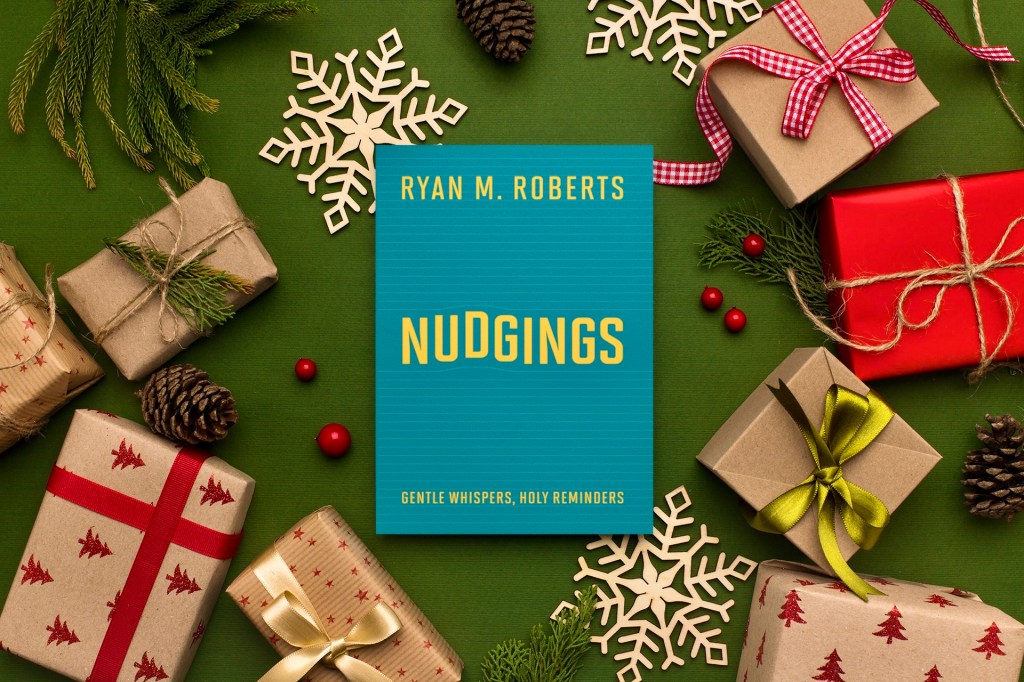
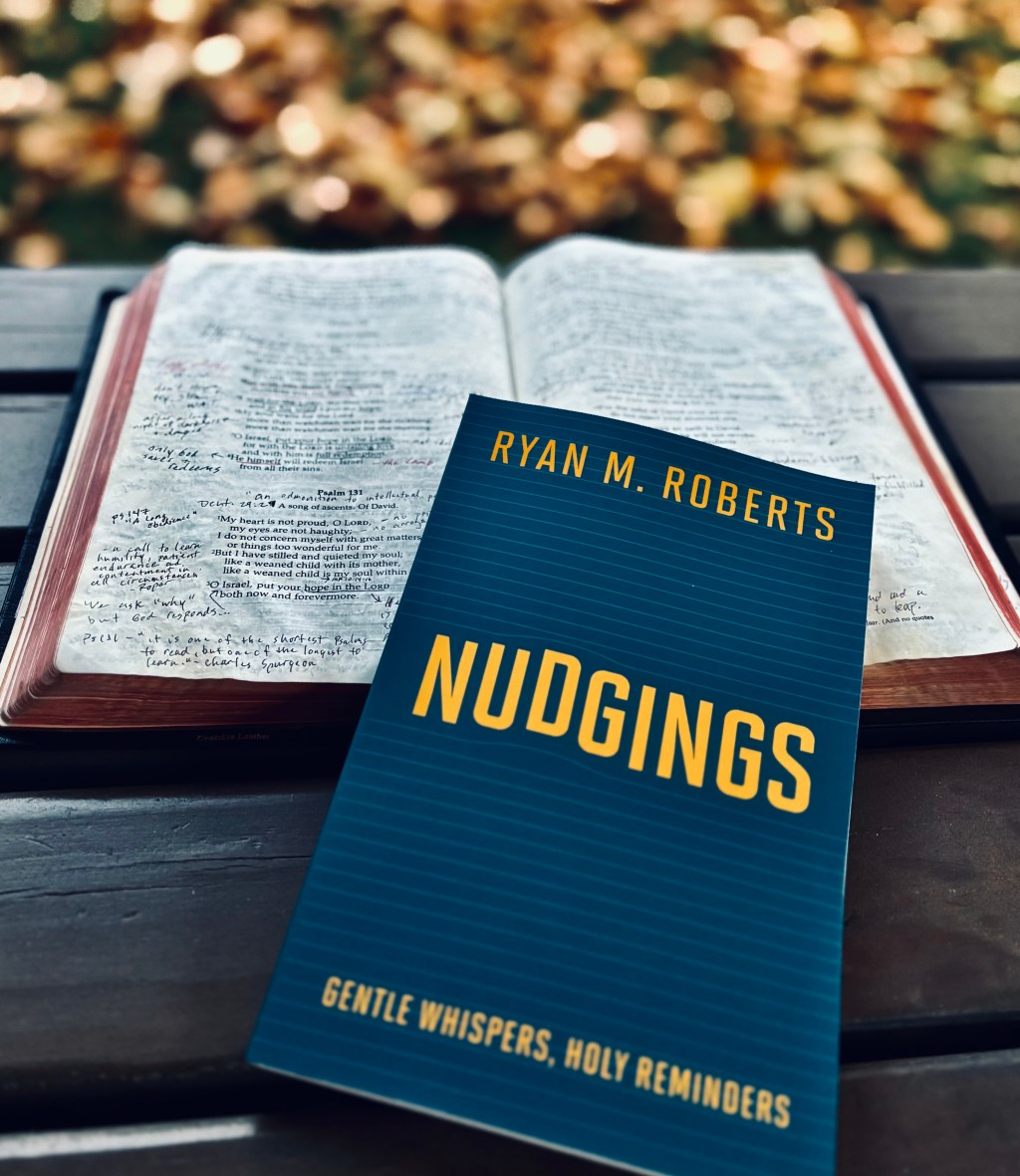
    Wow… Nudgings: Gentle Whispers, Holy Reminders was just listed as the #1 New Release in Spiritual Meditations on Amazon!
     

    I’m so grateful—for every reader, encourager, and friend who has shared these reflections, prayed, or helped spread the word.

    My hope is still the same: that these pages help people slow down and hear God’s gentle whispers in the everyday.

    If you haven’t picked up a copy yet (or want one for a friend), here’s the link: hsnudgings.com

    Thank you again for helping spread the word.

    God is speaking… are you listening?

  • Nudging #111 – Oct. 16, “The Little Things”


    “Keep a sharp eye out for weeds of bitter discontent. A thistle or two gone to seed can ruin a whole garden in no time. Watch out for the Esau syndrome: trading away God’s lifelong gift in order to satisfy a short-term appetite.”

    — Hebrews 12:15–16 (MSG)

    When I was a kid, I’d ride with my grandad as he pulled the sprayer behind the tractor. Every spring we’d drive along the ditches, hunting thistles. He’d mix the water and 2,4-D, then sit me up on the hood of the tractor and tell me to use my “good eyes” to spot the weeds. I didn’t understand why we bothered. But he knew what I didn’t—that if you let a few go to seed, you’d fight them for years.

    That image has stayed with me. Because that’s how the heart works, too. A little seed of desire, a little craving, a little compromise—it doesn’t look like much. A hint of bitterness, a whisper of complaint, a quiet disappointment left alone—it all takes root. And left unchecked, it spreads.

    Hebrews says, “A thistle or two gone to seed can ruin a whole garden in no time.” Then, right on the heels of that warning, it brings up Esau—the man who traded his birthright for a bowl of stew. What connects a weed to a meal? Appetite.

    Esau’s undoing didn’t start in the kitchen. It started with a seed—a subtle, inward hunger that grew unchecked. He let his need in the moment outweigh his inheritance for a lifetime. A small craving led to great loss.

    In Scotland, the thistle is admired. Its purple bloom stands proud against the wind. But move it into farmland, and it’s a menace. It spreads fast, drinks deep, and chokes out everything good. What’s prized in one place becomes poison in another.

    That truth found its way across an ocean. In the 1800s, a Scottish settler sent a packet of thistle seeds to Australia, thinking them lovely—decorative, even charming. But once they hit the soil, they multiplied like wildfire.


    Within a few short years, the thistles covered pastures and roadsides, killing crops and stealing life from the land. The problem grew so bad that in 1852 the government passed “The Thistle Act,” requiring landowners to destroy every thistle—or face a fine. What began as beauty became bondage.

    That’s how the enemy works. Not with a tsunami, but with a seed. He doesn’t need to topple your faith in one strike—just plant something small: a hint of resentment, a whisper of complaint, a tiny “need” that grows into entitlement.

    The devil is diabolical, not always dramatic. He prowls in pretense—silently roaring in the subtle. Hebrews says Esau wept for what he’d lost, but by then it was too late—tears or no tears. It’s a sobering reminder: the seeds we plant today will bear fruit tomorrow, for better or worse.

    So before the weeds take root—before discontent hardens into bitterness, before appetite becomes addiction, and before the small trade turns into lifelong loss—let the “good eyes” of the Lord search the soil of your heart. Let Him pull what doesn’t belong.

    The tears of regret are bitter, but thanks to Jesus, the tears of repentance lead to life. In the end, the garden of your soul and life is shaped by the quiet seeds, the unseen choices—the little things.

    Buy the book Nudgings at: hsnudgings.com

  • Nudgings Is Here!


    Friends,

    Today’s the day — Nudgings: Gentle Whispers, Holy Reminders is now available on Amazon!

    This book began with a few reflections in my journal about the ways God was nudging me — gentle reminders of His grace and presence. I shared a few of them on my blog and social media, and over time those words began encouraging others. That’s how Nudgings was born.

    This is my prayer: that Nudgings will help people slow down, notice God’s presence, and hear His voice in the middle of everyday life.

    God is speaking. Are you listening?

    If you’d like to help share the message of Nudgings with others, here are two simple ways:

    1. Get a copy: Each purchase helps the book reach more people on Amazon who might need a gentle reminder that God is near.

    2. Leave a review: Reviews make a big difference. They don’t just encourage me — they help them Amazon website place Nudgings where more people can see it and, hopefully, hear from God through it.

      This isn’t about selling books. It’s about helping people hear the gentle, steady voice of Jesus.

      Thank you for praying, encouraging, and walking with me in this journey. My prayer is that Nudgings will glorify God and lift up Jesus.

      Gratefully,
      Ryan

    1. Nudging #110 – Oct. 9, “Where God Comes Near”


      The Word became flesh and blood, and moved into the neighborhood. We saw the glory with our own eyes, the one-of-a-kind glory, like Father, like Son, Generous inside and out, true from start to finish. 

      — John 1:14, MSG

      Years ago, when my wife was teaching kindergarteners, I’d stop by her classroom from time to time to say hi and visit with her students. One day I walked in her room and nearly tripped over a globe sitting right in the middle of the floor. 

      A globe on the floor? 

      It looked out of place. My first instinct was to pick it up and put it on a shelf. After all, that’s where globes belong—somewhere “safe” and “appropriate.”

      But here’s the thing about a globe on the floor of a kindergarten classroom: it’s meant to be touched, looked at, and held. Little fingers will leave smudges. Sticky hands will spin it, bump it, scuff it, maybe even knock it over. And that’s okay. It’s not meant to stay polished or pristine — it’s meant to be experienced, up close and together, by kids who are learning about the world one fingerprint at a time.

      Every mark and sign of wear on that globe tells the story of a teacher who values connection more than control. A great teacher always chooses access and engagement over perfection.

      And that makes me think of Jesus.

      The Creator of all things — the Word who spoke galaxies into place — moved into the neighborhood. He came into the grit and grief of our world — unguarded, vulnerable, and willing. His coming was dangerous. It was deliberate. It was love—and it cost Him everything.

      The Greatest Teacher chose access and engagement over perfection.

      That’s what grace does: it meets us at our level. God could have stayed exalted and out of reach. But He stepped into the dust and difficulty of our world so that we could actually know Him. Not just know about Him, but know Him. And that knowing came through suffering and a cross.

      Jesus said, “I have come that they may have life, and have it to the full” (John 10:10, NIV). That life came at the cost of His own life — “the Son of Man came not to be served but to serve, and to give His life as a ransom for many” (Mark 10:45, NIV).

      Jesus has come close—to your neighborhood, your life, your heart. He’s ever knocking, waiting for you to open the door (Revelation 3:20). He’s not put off by the clutter, the chaos, or the imperfection. He came and gave His life to make you clean.

      So go ahead—let Him in. Let Him take His place at the center of things.

      That’s where real growth and life begin—in the beautiful, messy, risky place…

      where God comes near.